
Alexandrite:
Basic facts:
Birthstone: June
Origin: Russia, Brazil, India, Sri Lanka & Tanzania
Colors: Green to red is most common but also occurs as blue to purple/red
Family: Chrysoberyl: BeAl2O4
Hardness: 8.5
Refractive Index: 1.74 – 1.76
Specific Weight: 3.70 – 3.78
Treatment: Not treated
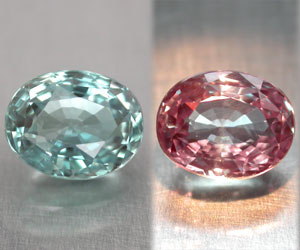
Known in Russia as the Tsar's Gemstone, alexandrite is truly a miraculous gemstone. Often described as an "emerald by day" and "ruby by night", when viewed in sunlight, alexandrite displays a green color but when viewed under candlelight, the color appears as red, violet, raspberry, purple or orange.
Scarce availability, remarkable color change and a sparkling diamond-like luster, make alexandrite a "must have" for every true jewelry connoisseur. A rare variant of chrysoberyl, alexandrite ranks alongside ruby and sapphire as one of the world's most sought-after gemstones.
Myths and legends
Early one cold October morning in 1830, a Russian peasant, Maxim Stefanovitch Koshevnikov, was walking through the birch forest along the banks of the Tokovaya River. According to legend, he tripped on a couple of roots from a large tree felled by a storm. At his feet he discovered some green stones which were quickly identified as emeralds. It wasn't long before these wonderful emeralds began to be mined from Russia's Ural Mountains.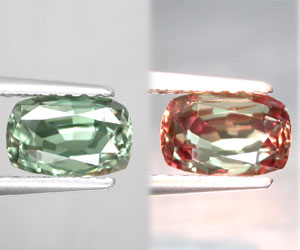 The Russian emerald mines yielded other treasures as well, including a new gemstone that had the strange ability to change color. When viewed in sunlight, rich green colors appeared but when viewed under candlelight, reddish hues appeared. The gemstone was named alexandrite after the young Tsarevitch, who was crowned Tsar Alexander II in 1855.
Legend has it that alexandrite was discovered by emerald miners on Tsar Alexander's birthday, April 23, 1830. However, the stories differ and Vitaliy Repej, a Ukrainian alexandrite specialist, instead believes that alexandrite was actually discovered on April 3, 1834, by the Tsar's famous Finnish mineralogist, Dr. Nils Nordenskjöld , and was not officially called alexandrite until 1842.
Interestingly, the color change effect is not unique to alexandrite. Many gemstone types can show a color change, such as sapphire and garnet. However, the degree of color change exhibited by alexandrite is among the most extreme found in natural gemstones.
Similar to emeralds, inclusions are a common feature of alexandrite. Inclusions often help confirm an alexandrite's origin. Given the prevalence of synthetic alexandrites, inclusions are also a hallmark of authenticity that helps us distinguish genuine stones from man-made ones.
Some alexandrite stones have an optical effect that reflects like the cat's eyes. This is an intriguing phenomenon caused by parallel inclusions that concentrate the light into a single band. For the stone to have this effect, the stone must be cut like a cabochon.
Although alexandrite is available from other places, it is the Russian alexandrites that are most sought after and rare.
Although the Ural mines closed after only a couple of decades, limited mining continues today. In the area around Malysheva, alexandrite and emerald are mined as byproducts of beryllium.
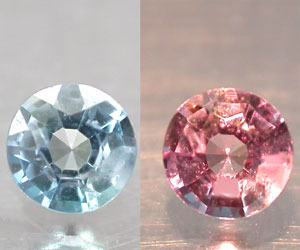
While gems from the famous Brazilian state of Minas Gerais have enchanted the world for over 100 years, a major new find was made in 1987 at Hematita. Similar to other mines containing pegmatite rocks, Brazilian alexandrite has been found in rugged areas that can be difficult to access. Usually these are mined with primitive hand tools, and one of the most famous is the Hematita mine, whose beautiful alexandrite is now quite rare. Although the majority of Brazilian alexandrites have large inclusions, a small amount of better quality stones have been found. In 2004, a new deposit was found which gives blue-green alexandrite which changes to a lovely raspberry red colour.
Mines in Madagascar, Tanzania and Mozambique have produced good quality alexandrite for several years, but not in large quantities.
Basic facts:
Birthstone: June
Origin: Russia, Brazil, India, Sri Lanka & Tanzania
Colors: Green to red is most common but also occurs as blue to purple/red
Family: Chrysoberyl: BeAl2O4
Hardness: 8.5
Refractive Index: 1.74 – 1.76
Specific Weight: 3.70 – 3.78
Treatment: Not treated
Known in Russia as the Tsar's Gemstone, alexandrite is truly a miraculous gemstone. Often described as an "emerald by day" and "ruby by night", when viewed in sunlight, alexandrite displays a green color but when viewed under candlelight, the color appears as red, violet, raspberry, purple or orange.
Scarce availability, remarkable color change and a sparkling diamond-like luster, make alexandrite a "must have" for every true jewelry connoisseur. A rare variant of chrysoberyl, alexandrite ranks alongside ruby and sapphire as one of the world's most sought-after gemstones.
Myths and legends
Early one cold October morning in 1830, a Russian peasant, Maxim Stefanovitch Koshevnikov, was walking through the birch forest along the banks of the Tokovaya River. According to legend, he tripped on a couple of roots from a large tree felled by a storm. At his feet he discovered some green stones which were quickly identified as emeralds. It wasn't long before these wonderful emeralds began to be mined from Russia's Ural Mountains.
Legend has it that alexandrite was discovered by emerald miners on Tsar Alexander's birthday, April 23, 1830. However, the stories differ and Vitaliy Repej, a Ukrainian alexandrite specialist, instead believes that alexandrite was actually discovered on April 3, 1834, by the Tsar's famous Finnish mineralogist, Dr. Nils Nordenskjöld , and was not officially called alexandrite until 1842.
Interestingly, the color change effect is not unique to alexandrite. Many gemstone types can show a color change, such as sapphire and garnet. However, the degree of color change exhibited by alexandrite is among the most extreme found in natural gemstones.
Similar to emeralds, inclusions are a common feature of alexandrite. Inclusions often help confirm an alexandrite's origin. Given the prevalence of synthetic alexandrites, inclusions are also a hallmark of authenticity that helps us distinguish genuine stones from man-made ones.
Some alexandrite stones have an optical effect that reflects like the cat's eyes. This is an intriguing phenomenon caused by parallel inclusions that concentrate the light into a single band. For the stone to have this effect, the stone must be cut like a cabochon.
Although alexandrite is available from other places, it is the Russian alexandrites that are most sought after and rare.
Although the Ural mines closed after only a couple of decades, limited mining continues today. In the area around Malysheva, alexandrite and emerald are mined as byproducts of beryllium.
While gems from the famous Brazilian state of Minas Gerais have enchanted the world for over 100 years, a major new find was made in 1987 at Hematita. Similar to other mines containing pegmatite rocks, Brazilian alexandrite has been found in rugged areas that can be difficult to access. Usually these are mined with primitive hand tools, and one of the most famous is the Hematita mine, whose beautiful alexandrite is now quite rare. Although the majority of Brazilian alexandrites have large inclusions, a small amount of better quality stones have been found. In 2004, a new deposit was found which gives blue-green alexandrite which changes to a lovely raspberry red colour.
Mines in Madagascar, Tanzania and Mozambique have produced good quality alexandrite for several years, but not in large quantities.