
Diopside:
Basic facts:
Origin: Russia
Colors: Blue, brown, green, purple, black & white
Family: Pyroxene: CaMgSi2O6
Hardness: 5 - 6
Refractive Index: 1.66 – 1.73
Specific Gravity: 3.22 – 3.38
Treatment: Not treated
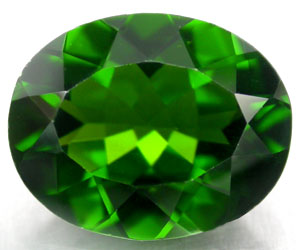
Diopside was named in 1800 from the Greek words DIS (double) and Opsis (vision), referring to the Pleochroism (different colors that appear when viewed from different angles) that diopside has in its prismatic form.
Myths and legends
Diopside is also called "the weeping gemstone" because crystal healers believe that diopside can heal trauma by inducing cleansing tears.
Diopside facts
Diopside is a calcium-magnesium silicate found in impure limestone, meteorites and igneous basalts. It was previously called schefferite, white schefferite and zinc-schefferite.
The mineral diopside is a magnesium-rich member of the clinopyroxene group.
Diopside crystals have a perfect cleavage in two directions. Mineralogists easily recognize diopside in the field by its crystal structure habit, color, fracture, cleavage and white or white-green streak.
Diopside is typically white, blue, purple, brown, green, colorless and gray with a vitreous luster. The less common shades are yellowish brown and greenish brown.
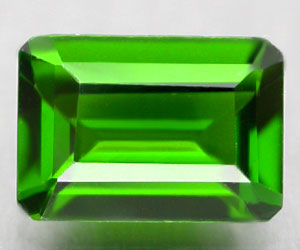
Varieties of diopside include chromium diopside (a chromium-rich diopside known for its deep green color), viola (a rare blue variety found in Italy), cat's eye diopside (green with the effect due to inclusions of rutile needles), malacolite ( a white colored variety), salaite (an iron variety), decalbite (an iron-free variety) and star diopside (a star with four rays).
Gem quality diopside is mined in Siberia, Burma, India, Italy, Sri Lanka, Brazil, Madagascar, South Africa and Pakistan. Uzbekistan, located between Tajikistan and Turkmenistan, has become an important location for a type of Russian diopside called tashmarine. This diversity has a slightly lower chromium content than the Siberian material, a less saturated color and may have some gray or brown tones. India has the largest deposits of cat's eye or star diopside. The color of African diopside tends to be a more yellowish color similar to peridot.
Chromium diopside
Chromium diopside has a beautiful rich green color, similar to that of fine emeralds or rare Tsavorite garnets. Colored by chromium, some claim this stone is beneficial for health, relationships, spirituality and financial success.
A major reason why chromium diopside is relatively unknown is that it has only recently become available in significant commercial quantities. Chromium diopside shows strong birefringence and has a vitreous luster.
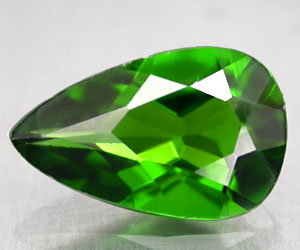
Chromium diopside is most often mined in Yakutia in Siberia (Russia). Yakutia territory located in northernmost Asia and is considered the coldest place in the northern hemisphere. Mining is limited due to cold winters that last for nine months, which means that this gem is seasonal and it has been difficult to maintain a steady supply. Interestingly, Yakutia is also the source of 99% of all Russian diamonds. Chromium diopside is a diamond mine indicator mineral and is sometimes found as an inclusion within diamonds. The liberalization of the economy in the former Soviet Union has made chromium diopside more available than ever before.
Star diopside
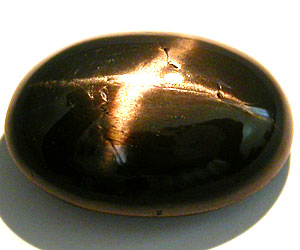
Star diopside is also known as black tar diopside because of its blackish color. Asterism, or star effect, is a reflection that appears as two or more intersecting bands of light across the surface of a gemstone. Star diopside has four rays, two of which are straight, while the other two are not at right angles to the first pair. This gemstone is mainly mined in India and is generally a black or blackish green color.
Cat's eye diopside
A green variety of diopside, chatoyancy or cat's eye is a reflection that appears as a single bright band of light across the surface of a gemstone. Cat's eye diopside is mainly mined in India, but is also found in Burma.
Basic facts:
Origin: Russia
Colors: Blue, brown, green, purple, black & white
Family: Pyroxene: CaMgSi2O6
Hardness: 5 - 6
Refractive Index: 1.66 – 1.73
Specific Gravity: 3.22 – 3.38
Treatment: Not treated
Diopside was named in 1800 from the Greek words DIS (double) and Opsis (vision), referring to the Pleochroism (different colors that appear when viewed from different angles) that diopside has in its prismatic form.
Myths and legends
Diopside is also called "the weeping gemstone" because crystal healers believe that diopside can heal trauma by inducing cleansing tears.
Diopside facts
Diopside is a calcium-magnesium silicate found in impure limestone, meteorites and igneous basalts. It was previously called schefferite, white schefferite and zinc-schefferite.
The mineral diopside is a magnesium-rich member of the clinopyroxene group.
Diopside crystals have a perfect cleavage in two directions. Mineralogists easily recognize diopside in the field by its crystal structure habit, color, fracture, cleavage and white or white-green streak.
Diopside is typically white, blue, purple, brown, green, colorless and gray with a vitreous luster. The less common shades are yellowish brown and greenish brown.
Varieties of diopside include chromium diopside (a chromium-rich diopside known for its deep green color), viola (a rare blue variety found in Italy), cat's eye diopside (green with the effect due to inclusions of rutile needles), malacolite ( a white colored variety), salaite (an iron variety), decalbite (an iron-free variety) and star diopside (a star with four rays).
Gem quality diopside is mined in Siberia, Burma, India, Italy, Sri Lanka, Brazil, Madagascar, South Africa and Pakistan. Uzbekistan, located between Tajikistan and Turkmenistan, has become an important location for a type of Russian diopside called tashmarine. This diversity has a slightly lower chromium content than the Siberian material, a less saturated color and may have some gray or brown tones. India has the largest deposits of cat's eye or star diopside. The color of African diopside tends to be a more yellowish color similar to peridot.
Chromium diopside
Chromium diopside has a beautiful rich green color, similar to that of fine emeralds or rare Tsavorite garnets. Colored by chromium, some claim this stone is beneficial for health, relationships, spirituality and financial success.
A major reason why chromium diopside is relatively unknown is that it has only recently become available in significant commercial quantities. Chromium diopside shows strong birefringence and has a vitreous luster.
Chromium diopside is most often mined in Yakutia in Siberia (Russia). Yakutia territory located in northernmost Asia and is considered the coldest place in the northern hemisphere. Mining is limited due to cold winters that last for nine months, which means that this gem is seasonal and it has been difficult to maintain a steady supply. Interestingly, Yakutia is also the source of 99% of all Russian diamonds. Chromium diopside is a diamond mine indicator mineral and is sometimes found as an inclusion within diamonds. The liberalization of the economy in the former Soviet Union has made chromium diopside more available than ever before.
Star diopside
Star diopside is also known as black tar diopside because of its blackish color. Asterism, or star effect, is a reflection that appears as two or more intersecting bands of light across the surface of a gemstone. Star diopside has four rays, two of which are straight, while the other two are not at right angles to the first pair. This gemstone is mainly mined in India and is generally a black or blackish green color.
Cat's eye diopside
A green variety of diopside, chatoyancy or cat's eye is a reflection that appears as a single bright band of light across the surface of a gemstone. Cat's eye diopside is mainly mined in India, but is also found in Burma.