
Kunzite:
Basic facts:
Origin: Afghanistan, Brazil, Madagascar, Nigeria & Pakistan
Colors: Variants of pink and yellow
Family: Spodumene: LiAlSi2O6
Hardness: 6 – 7
Refractive Index: 1.66 – 1.68
Specific Gravity: 3.15 – 3.21
Treatment: Usually not treated
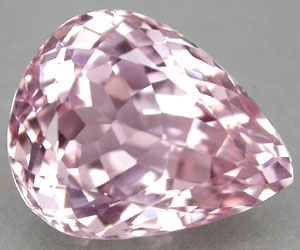
First discovered in California in 1902 (some sources say around 1877), Kunzite is named after Tiffany's legendary gemologist and famous gem writer, George Frederick Kunz.
Kunz described this durable pink gemstone as having two distinct properties: phosphorescence—where, like diamond, Kunzite glows in a dark room after being exposed to the sun's ultraviolet rays—and Pleochroism—showing different colors when viewed from different angles. These phenomena are best seen in larger kunzite gemstones as in jewelry such as pendants, earrings and rings with claw settings that allow light to flow freely through them.
Kunzite radiates gorgeous pastel pinks, frosty lilacs, cool lavenders, warm fuchsias and rich orchids under the warm glow of a light bulb (candle).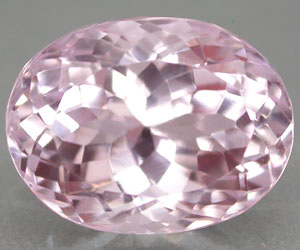
Myths and legends
Aside from their obvious physical beauty, pink gemstones have potent metaphysical properties. Alternative healers use a variety of pink gemstones associated with the heart chakra. The fourth of seven energy points that run under the human body, the heart chakra is believed to carry emotional feelings of love and compassion. Some believe that when the fourth chakra is blocked we experience emotions such as anxiety, fear, anger and frustration. Crystal healers use properties of pink gemstones such as pink tourmaline and Kunzite to free the heart chakra from negative energy.
Kunzite facts
The lithium in Kunzite's chemical composition, lithium aluminum silicate, together with trace amounts of manganese, gives the wonderful pink colors that kunzite possesses. As a member of the spodumene family, Kunzite is closely related to Hiddenite, a green variety of spodumene. Hiddenite is an attractive gemstone but is extremely rare and mostly known only by collectors. Hiddenite was discovered in 1800 in Hiddenite, a town in Alexander County, North Carolina, USA. Both the town and the gem were named after William Earl Dold, a mineralogist and mining director from Newark, New Jersey who mined in the area. For many years Hiddenite was confined to North Carolina, but new deposits have recently been discovered in Madagascar and Brazil. Green spodumene must contain trace amounts of chromium to be called Hiddenite.
Spodum's colors depend on trace elements of iron (which produces yellow to green), chromium (which produces medium to deep green) or manganese (which produces pink to purple).
The name spodumen (named by BJ D'Andrada Sylva in 1800) is derived from the Greek spodumenos, meaning "burnt to ashes" in reference to the light gray color of some spodumens.
While Kunzite is usually considered a pink to purple gemstone, yellow Kunzite, mint Kunzite and white Kunzite are trade names used to describe yellow, light green and colorless spodumene.
Kunzite is strongly pleochroic, which means that there is a color intensity variation and change when the crystal is viewed from different angles. A gem cutter must carefully consider the position of the stone to maximize color.
Basic facts:
Origin: Afghanistan, Brazil, Madagascar, Nigeria & Pakistan
Colors: Variants of pink and yellow
Family: Spodumene: LiAlSi2O6
Hardness: 6 – 7
Refractive Index: 1.66 – 1.68
Specific Gravity: 3.15 – 3.21
Treatment: Usually not treated
First discovered in California in 1902 (some sources say around 1877), Kunzite is named after Tiffany's legendary gemologist and famous gem writer, George Frederick Kunz.
Kunz described this durable pink gemstone as having two distinct properties: phosphorescence—where, like diamond, Kunzite glows in a dark room after being exposed to the sun's ultraviolet rays—and Pleochroism—showing different colors when viewed from different angles. These phenomena are best seen in larger kunzite gemstones as in jewelry such as pendants, earrings and rings with claw settings that allow light to flow freely through them.
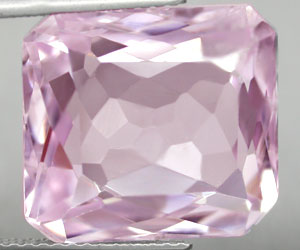
Kunzite radiates gorgeous pastel pinks, frosty lilacs, cool lavenders, warm fuchsias and rich orchids under the warm glow of a light bulb (candle).
Myths and legends
Aside from their obvious physical beauty, pink gemstones have potent metaphysical properties. Alternative healers use a variety of pink gemstones associated with the heart chakra. The fourth of seven energy points that run under the human body, the heart chakra is believed to carry emotional feelings of love and compassion. Some believe that when the fourth chakra is blocked we experience emotions such as anxiety, fear, anger and frustration. Crystal healers use properties of pink gemstones such as pink tourmaline and Kunzite to free the heart chakra from negative energy.
Kunzite facts
The lithium in Kunzite's chemical composition, lithium aluminum silicate, together with trace amounts of manganese, gives the wonderful pink colors that kunzite possesses. As a member of the spodumene family, Kunzite is closely related to Hiddenite, a green variety of spodumene. Hiddenite is an attractive gemstone but is extremely rare and mostly known only by collectors. Hiddenite was discovered in 1800 in Hiddenite, a town in Alexander County, North Carolina, USA. Both the town and the gem were named after William Earl Dold, a mineralogist and mining director from Newark, New Jersey who mined in the area. For many years Hiddenite was confined to North Carolina, but new deposits have recently been discovered in Madagascar and Brazil. Green spodumene must contain trace amounts of chromium to be called Hiddenite.
Spodum's colors depend on trace elements of iron (which produces yellow to green), chromium (which produces medium to deep green) or manganese (which produces pink to purple).
The name spodumen (named by BJ D'Andrada Sylva in 1800) is derived from the Greek spodumenos, meaning "burnt to ashes" in reference to the light gray color of some spodumens.
While Kunzite is usually considered a pink to purple gemstone, yellow Kunzite, mint Kunzite and white Kunzite are trade names used to describe yellow, light green and colorless spodumene.
Kunzite is strongly pleochroic, which means that there is a color intensity variation and change when the crystal is viewed from different angles. A gem cutter must carefully consider the position of the stone to maximize color.