
Sphene (Titanite):
Basic facts:
Origin: Brazil, Madagascar, Mexico, Pakistan & Sri Lanka
Colors: Yellow/green
Family: Sphene: CaTiSiO5
Hardness: 5 – 5.5
Refractive Index: 1.84 – 2.11
Specific Weight: 3.52 – 3.54
Treatment: Normally not treated
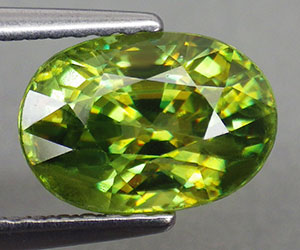
Sphene is named after the Greek word for wedge, as its crystals are normally wedge-shaped. Because it contains titanium, sphene is also sometimes referred to by its mineral name titanite.
One of the world's newest and rarest gemstones, sphene has the rather unusual ability to take a beam of light and split it into all spectral colors. In this respect, sphene is superior to diamond. This combined with its strong Pleochroism (different colors appear when the gemstone is viewed from different angles) has the effect that the gemstone appears to change color.
Sphene is predominantly green or yellow-green, with almost every other color of the rainbow showing through its intense fiery brilliance.
Sphene facts
Sphene are fantastically luminous, brilliant gemstones that have a higher dispersion (brilliant) than diamonds.
Sphene's magnificent luster, unique hues, strong pleochroism, (diamond-like) luster and birefringence make sphene ideal for jewelry that catches the light to show sphene's sparkling qualities to full effect. A unique property of sphene is double refraction (doube refraction), which means that light splits into two rays as it passes through the stone.
Basic facts:
Origin: Brazil, Madagascar, Mexico, Pakistan & Sri Lanka
Colors: Yellow/green
Family: Sphene: CaTiSiO5
Hardness: 5 – 5.5
Refractive Index: 1.84 – 2.11
Specific Weight: 3.52 – 3.54
Treatment: Normally not treated
Sphene is named after the Greek word for wedge, as its crystals are normally wedge-shaped. Because it contains titanium, sphene is also sometimes referred to by its mineral name titanite.
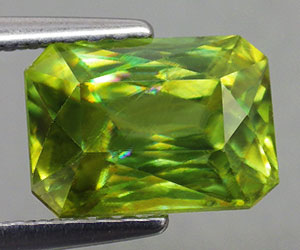
One of the world's newest and rarest gemstones, sphene has the rather unusual ability to take a beam of light and split it into all spectral colors. In this respect, sphene is superior to diamond. This combined with its strong Pleochroism (different colors appear when the gemstone is viewed from different angles) has the effect that the gemstone appears to change color.
Sphene is predominantly green or yellow-green, with almost every other color of the rainbow showing through its intense fiery brilliance.
Sphene facts
Sphene are fantastically luminous, brilliant gemstones that have a higher dispersion (brilliant) than diamonds.
Sphene's magnificent luster, unique hues, strong pleochroism, (diamond-like) luster and birefringence make sphene ideal for jewelry that catches the light to show sphene's sparkling qualities to full effect. A unique property of sphene is double refraction (doube refraction), which means that light splits into two rays as it passes through the stone.