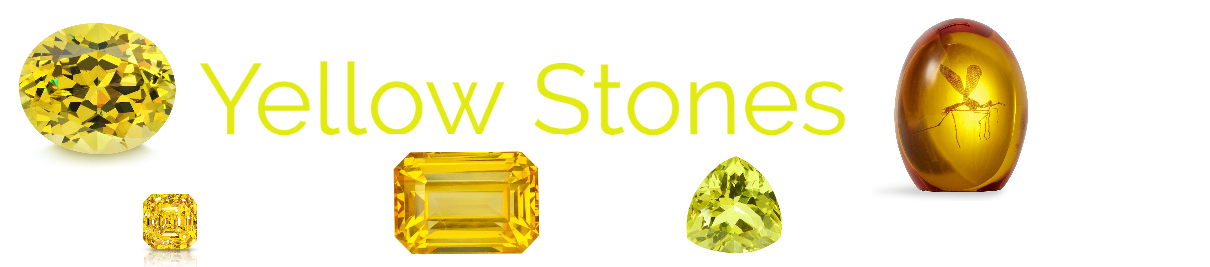
From bright, sunny colors to deep golden hues, yellow gemstones are warm and inviting. If you are looking for a yellow stone, you will find what you are looking for here. Gemologists assess color by considering hue, tone and color saturation. For yellow gemstones, the primary hue should be yellow. The most valuable stones are a pure yellow shade, but secondary shades may occur.
Citrine
Citrine Quartz
Diamond
Sapphire
Golden Beryl
Garnet
Tourmaline
Zircon
Amber
Fire Opal
Sphene
Sphalerite
Citrine
The most popular yellow gemstone by far is citrine, the modern birthstone for November. This variety of quartz is yellow to orange or brown, and due to the abundance of quartz in the earth's crust, it is a very valuable stone. Nevertheless, this mineral is a durable jewelry stone with a hardness of on the Moh's hardness scale.
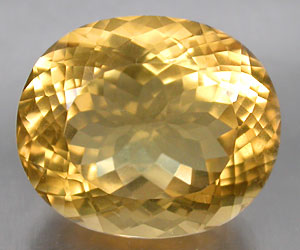
The color of citrine comes from small amounts (about 40 parts per million) of iron in the crystal structure of quartz. The name citrine comes from the French word citron.
Lemon Quartz
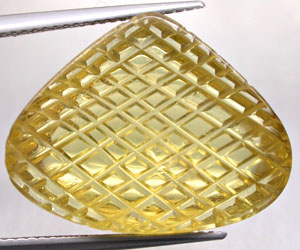
Lemon Quartz, (also known as Lemon Citrine, Lemon Topaz) is a gemstone formed by heating amethyst, yellow quartz and iron together at very high temperatures.
Diamond
On the slightly more upscale side, yellow diamonds can be stunning. When you think of April's monthstone, you probably imagine a colorless, white diamond. However, some gemologists believe that a diamond's true color is yellow. In fact, the GIA D to Z color grading scale for colorless diamonds rates these stones on how little yellow tint they have! The nitrogen content in the carbon crystal causes the yellow color in diamonds.
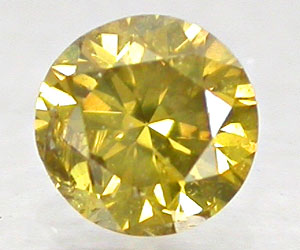
Most fancy colored diamonds including yellow are treated (often with irradiation). This type of treatment replicates the natural process (which in the earth takes several million years). The fancy colored diamonds that are all natural/untreated are very rare and thus valuable. These types of diamonds are actually significantly more valuable than a similar white (weight/clarity) diamond is.
Sapphire
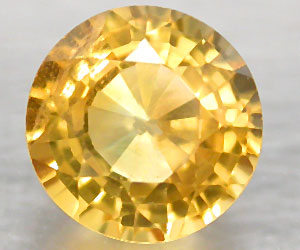
Most people associate sapphire with blue, but sapphire actually comes in all colors except red (red corundum is classified as ruby). Yellow sapphires are much cheaper than their blue and pink counterparts but still attractive. The iron content of sapphire gives these lovely yellow hues, and heat treatment or irradiation can enhance this color.
Golden Beryl and Heliodor
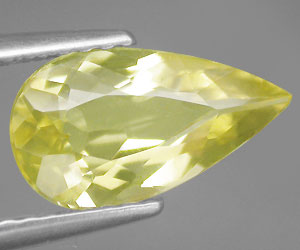
Heliodor, or golden beryl, is the emerald's lesser-known sibling. Because they are both varieties of the mineral beryl, some retailers market heliodor as "yellow emerald", but this is a misnomer. Golden beryl stones can have a light color and are often cut in so-called fancy cuts. These stones sometimes undergo radiation treatment to enhance the color.
Garnet
Perhaps one of the most stunning yellow gemstones is garnet. While most people know this birthstone for January for its reddish-brown hues, it can be almost any color. Hessonite, a type of grossular garnet, can be yellow-skinned.
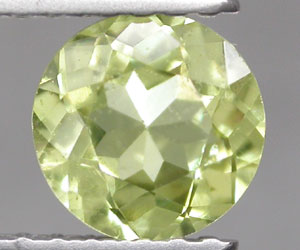
Much more spectacular is demantoid garnet, the yellow/green variety of andradite garnet. This gemstone has a luster and dispersion better than that of diamonds.
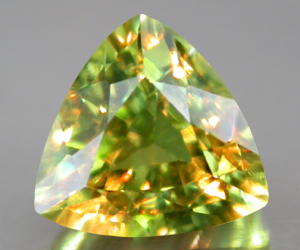
Mali garnets are formed by a mixture of andradite and grossular chemistry, and these beauties also exhibit high dispersion and brilliance.
Tourmaline
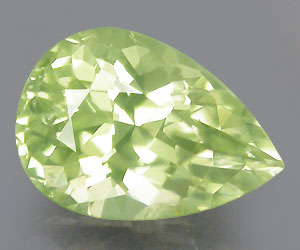
Although tourmalines occur in almost every color of the rainbow, yellow hues in this October birthstone are very rare. As a result, the yellow tourmalines you find for sale often contain inclusions and can command high prices. The yellow color in tourmaline comes from the manganese in the crystal structure. Known for multi-colored stones, a bi-colored tourmaline with yellow hues is a true rarity.
Zircon
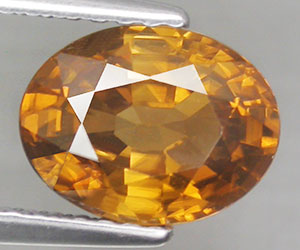
Although often associated with blue, this birthstone for December can display almost any color. The wonderful luster of zircon makes it an excellent and common diamond substitute. Shades of yellow can be bright and attractive but are often the result of heat treatment.
Amber
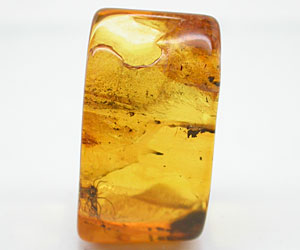
Amber consists of petrified resin and is often found in a yellow/brown color. Amber sometimes contains insects that got stuck in the resin when the walker was sticky millions of years ago.
This organic gemstone takes over 30 million years to form into what we have today. Deep yellow shades are the most desirable and are slightly more expensive than others. Still, amber is very affordable. However, this material is rare in large sizes. Keep in mind that large pieces of amber on the market may have been reconstructed from small pieces.
Fire Opal
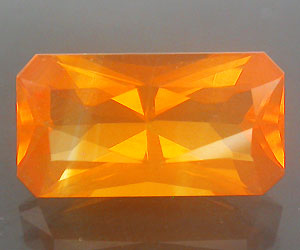
The "fire" in fire opal refers to the stone's body color, which ranges from yellow to red. This opal can be translucent or transparent and does not show the same play of color as a 'classic' opal. Mexico is the largest producer of fire opal, and the term "Mexican opal" refers to fire opal.
Sphene
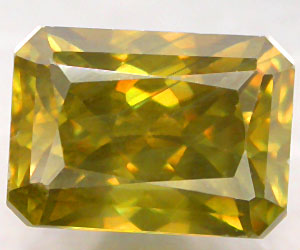
Sphene is named after the Greek word for wedge, as its crystals are normally wedge-shaped. Because it contains titanium, sphene is also sometimes referred to by its mineral name titanite. One of the world's newest and rarest gemstones, sphene has the rather unusual ability to take a beam of light and split it into all spectral colors. In this respect, sphene is superior to diamond. This combined with its strong Pleochroism (different colors appear when the gemstone is viewed from different angles) has the effect that the gemstone appears to change color.
Sphalerite
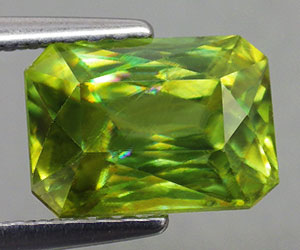
Sphalerite is a very rare collectible stone with a luster better than even diamonds! This stone is usually dark brown or black, but in rare cases stones are found that produce wonderful yellow/green/red stones that can be faceted. The name Sphalerite was introduced in 1847 by E.F. Bells. Sphalerite stones also have a very strong pleochroism. In a stone that is pleochroism, you can see two or more different shades of color depending on the angle at which you look at the stone. High quality Sphalerite stones often have a wonderful, almost rainbow-like color when you see the stone in, for example, sunlight.